

Looking to shake up your workout routine? You might want to consider hybrid exercise training, which combines heart-pumping aerobic action with muscle-strengthening moves in the same exercise session. The strategy has the advantage of meeting two key goals of the federal Physical Activity Guidelines in one fell swoop. And it also appears to be one of the best — and most time-efficient — ways for people who are overweight to lower their risk of cardiovascular-related risk factors, according to a new study (see “A comparison of 5 workout strategies”).
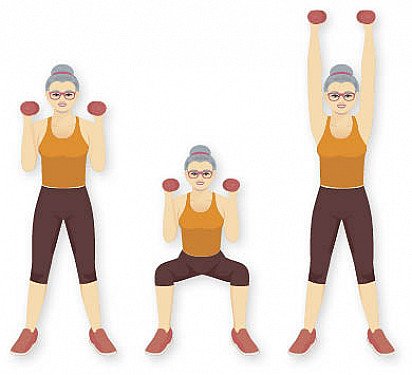
“Like many fitness trends, hybrid training likely started in the athletic <a says Dr. I-Min Lee, a professor of medicine at Harvard Medical School who studies the role of physical activity in disease prevention. It's not exactly a novel concept, since people have been informally combining types of exercise (such as carrying small weights to do biceps curls while walking) for a while, she points out. And fitness classes often feature combination moves, such as a squat plus an overhead press, known as a thruster (see illustration). A hybrid workout would consist entirely of these kinds of moves, which work several major muscle groups while simultaneously boosting your heart rate.
A comparison of 5 workout strategies
The federal Physical Activity Guidelines recommend the following goals for adults:
- at least 150 minutes weekly of moderate-intensity aerobic activity, or 75 minutes weekly of vigorous-intensity aerobic activity, or an equivalent combination of both
- muscle-strengthening activities on at least two days a week.
Are some exercise strategies more effective than others for improving factors that influence the risk of heart disease? To find out, researchers identified five categories of workouts:
1. continuous endurance training: aerobic exercise (such as brisk walking, cycling, or swimming) done for at least 20 minutes at a steady intensity, without any rest periods
2. interval training (also known as high-intensity interval training): alternating periods of high- and low-intensity aerobic exercise
3. resistance training: muscle-strengthening exercises, including the use of free weights, weight machines, and resistance bands
4. combined training: aerobic and resistance exercises performed consecutively in a single session
5. hybrid training: exercises that are both aerobic and strength-based, done at various levels of intensity during a single session.
For the analysis, researchers pooled findings from 81 studies involving people who were overweight or obese. The 4,330 participants had an average age of 39, and 59% were women. Measurements of interest included <a s also the most time-consuming. In the study, that kind of training took an average of 187 minutes per week. The hybrid training, in contrast, took an average of 128 minutes per week.
The one caveat is that performing hybrid exercises may be more challenging than doing aerobic and strength exercises consecutively. As Dr. Lee points out, the study included younger people without any known health problems aside from being overweight or obese. “So, it’s not clear if these findings translate to older people or those with health conditions,” she cautions.
Why strong muscles matter
The main take-home message is to make sure you’re adding strength-based exercises to your routine in whatever way makes the most sense for you. Strong muscles boost your basal metabolic rate — the amount of energy your body needs to keep working when you’re not moving. That improves weight-loss efforts by ramping up the number of calories you burn. Building muscle mass also appears to help prevent and improve <a s Workout Workbook has sample exercise routines that can be tailored to your fitness level (to order, go to /ww).
About the Author
Julie Corliss,
Executive Editor, Harvard Heart Letter
Julie Corliss has been the executive editor of the Harvard Heart Letter since 2013. She also writes for the Harvard Health Letter, Harvard Women’s Health Watch, and Harvard Men’s Health Watch, as well as for Harvard …
