


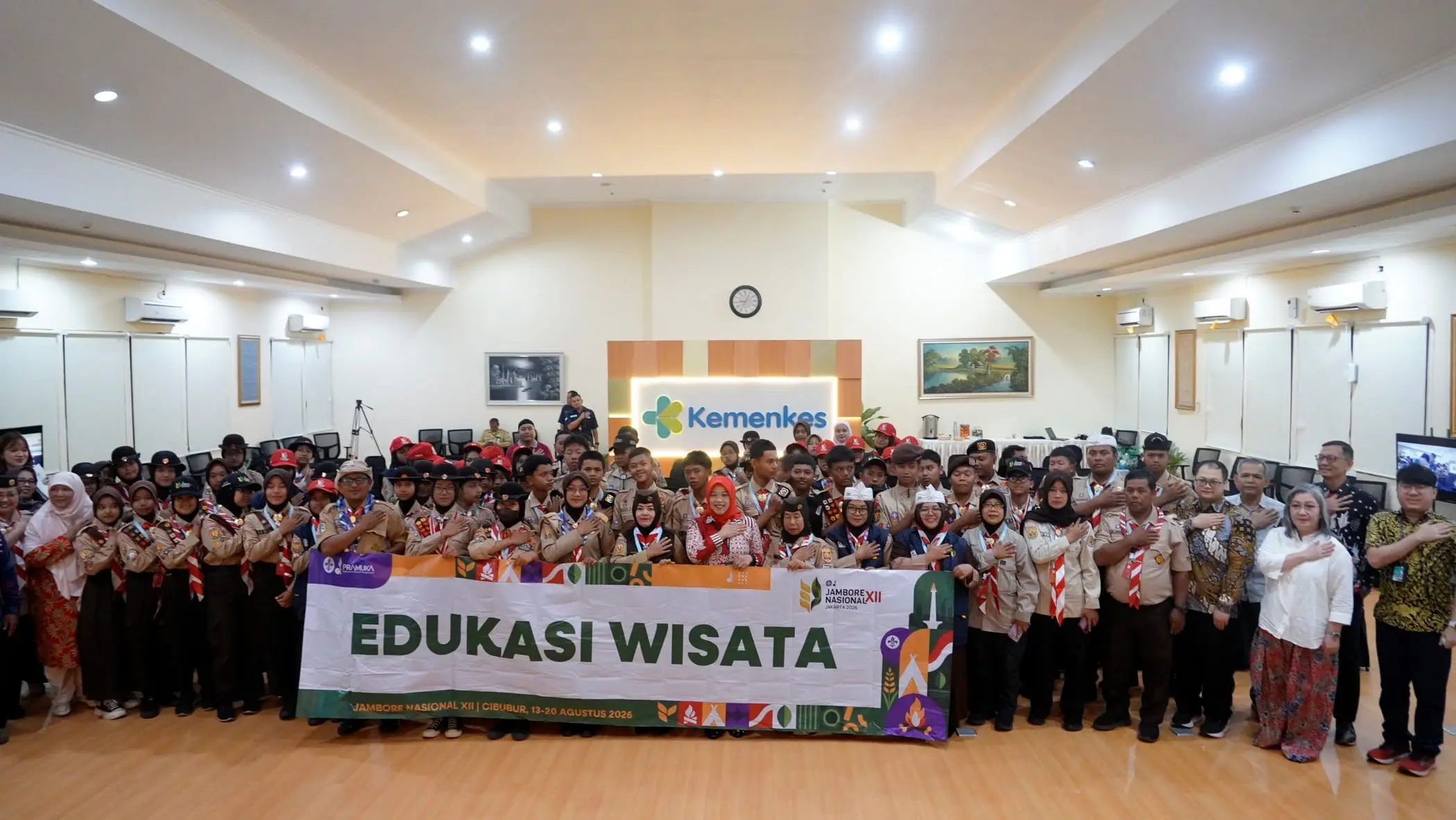
Jakarta – A total of 300 junior high school (SMP) Scouts participants who are members of the 12th National Jamboree in 2026 participated in a three-day health education tour at the Ministry of Health. The activity, facilitated by the Health Development Policy Agency (BKPK) on Jalan Percetakan Negara, Central Jakarta, aims to broaden knowledge of genetics, promote a healthy lifestyle, and foster leadership character in the younger generation to welcome Indonesia Emas 2045. The event took place from August 18-20, 2026.
BKPK Secretary Etik Retno Wiyati emphasized on the occasion that active involvement in scouting movements like Pramuka is crucial for the future. According to Etik, active participation in organizations during adolescence will foster discipline and independence, which are highly valued in the workplace.
“You don’t have to wait until you’re adults to contribute, you don’t have to wait until you become an official. Just become a member of the national jamboree. Start now, start with yourself, then expand to your family and your community,” Etik said in his remarks, while also entrusting the Scouts with the mission of <a s Directorate of Health Promotion (Promkes), and the National Scout Movement (Kwarnas), included visits to three interactive locations within the BKPK. These include the Health Policy Gallery, the BKPK Library, and the Theater and Audiovisual Room, designed to introduce the history of national health policy and the science of genomic medicine.
Also Read External Quality Improvement of SARS-CoV-2 Genome Sequencing Laboratory Network
Niken Wastu Palupi, Director of Health Promotion and Community Health at the Ministry of Health, highlighted the health challenges facing adolescents today, based on findings from the President’s free Quick Win health checkup program. Three major problems prevalent among adolescents are dental caries, lack of physical activity, and high rates of anemia. She urged Scout participants to become pioneers of a healthy lifestyle by limiting their sugar, salt, and fat (GGL) intake and engaging in at least 30–60 minutes of daily physical activity.
Niken also encouraged participants to avoid smoking and vaping, maintain environmental cleanliness, and register with Saka Bakti Husada. “Scouts are pioneers of healthy living in their communities. Cultivate healthy behaviors to prevent disease, for a progressive and prosperous Indonesia,” Niken said.
The participants’ mentors also expressed their high appreciation for this educational program. Hendrayani, a representative of the Mentoring Advisory Board from the Bandung Regency Branch Office in West Java, expressed her gratitude for the welcome from the Ministry of Health. According to Hendrayani, the practical and theoretical knowledge gained within the Ministry of Health is crucial for the scouts preparing to become members of Saka Bakti Husada.
Also Read Ensuring Standardized Health Regulations that Benefit the Community
“On behalf of the Scouts, we would like to express our gratitude for welcoming us to such a clean place. Yesterday in Cibubur, it was hot and dusty. This is the perfect place for the students to learn about the importance of maintaining their own health and the environment,” said Hendrayani (August 18).
Dudung, a Scout Leader representative from the group that arrived on Wednesday (September 19th), also welcomed the education program. He stated that the experience of participating in Saka Bakti Husada during school years greatly <a future careers, as they are accustomed to interacting with and being trained by healthcare professionals. However, Dudung also highlighted the fact that many schools in outlying or densely populated areas still lack free health screening facilities, and he hopes the Ministry of Health will improve their distribution.
Also Read The Need for Regulation to Ensure Good Health Services
In addition to healthy lifestyle education, participants also gained insight into genetic science from a researcher at the Center for Biomedical and Genomics in Health (BB Binomika). Widi explained that every human shares 99,6 percent of their DNA. This small 0,4 percent difference influences immunity, metabolism, and how a person responds to treatment.
In an interactive style, Widi explained the unique adaptations of the DNA of certain ethnic groups, such as the Bajo tribe in Indonesia, whose spleens are 50 percent enlarged, enabling them to dive to depths of 70 meters without equipment. He also explained how the people of Eastern Indonesia possess distinctively shaped red blood cells to fight malaria.
Widi emphasized that <a s DNA for optimal and safe healing.
“To carry this out, we need researchers in the laboratory, clinical doctors, and a digital team. In the future, you will be able to wholeheartedly contribute to society in any field that aligns with your expertise,” Widi concluded, encouraging the participants. (Author: Fachrudin Ali, Editor: HDI Work Team)
