


Since the late 2000s, the concept of self-care has moved from the edges of brand and customer consideration, and firmly entered the mainstream. Indeed, post-pandemic attitudes have furthered interest in health and wellbeing and, valued at $1.8 trillion today, BoF’s 2023 Beauty State of Fashion report found the global mental health, sleep quality and the ingredients and efficacy of beauty and skincare products.
Consequently, unique consumer demands have born out of this embrace of self-care products and services, with nearly one in five North American consumers — and one in three Millennials within the market — preferring personalised products and services within the self-care space, according to research by management consultancy firm McKinsey & Co. To meet demand, some brands will be able to emphasise existing products in their portfolios; others may have to rethink product formulations and strategy.
“One of the biggest shifts in consumer behaviour here is just how knowledgeable the customer is today — be that informed by fact or hearsay. There has been a reversal in terms of who’s leading the conversation,” Rennaï president and chief creative officer, Christopher Novak, told BoF. “When I first started in beauty, brands were in charge of telling customers what they needed. Now, customers are coming to brands with specific demands to meet their needs.”
Rennaï, a new beauty and self-care retailer, opened its doors in Royalmount Montréal in September. Placing emphasis on personalised self-care and counting more than 175 brands in its roster, the 36,000-square-foot space is divided into the “5 Realms of Rennaï”, spanning beauty, fragrance, self-care, wellness and product efficacy. It also holds an exclusive in-house medical aesthetic clinic and is the first in a series of North American store openings planned over the next five years.
Responsibly educating and inspiring its consumers is a core strategic focus. The store’s spatial design encourages shoppers to discover and define personalised beauty and self-care routines.
“At Rennaï, customer experience is about discovery and exploration. Our store realms exist because we want consumers to be immersed in that category or product or experience. This way, they can ask questions, build and share knowledge, and tie it altogether,” added Novak. “We believe the self-care space will evolve into services coming together — customers will want convenient access to a full self-care plan and we believe that the businesses that come from a place of expertise and authenticity will emerge as the new heritage brands.”
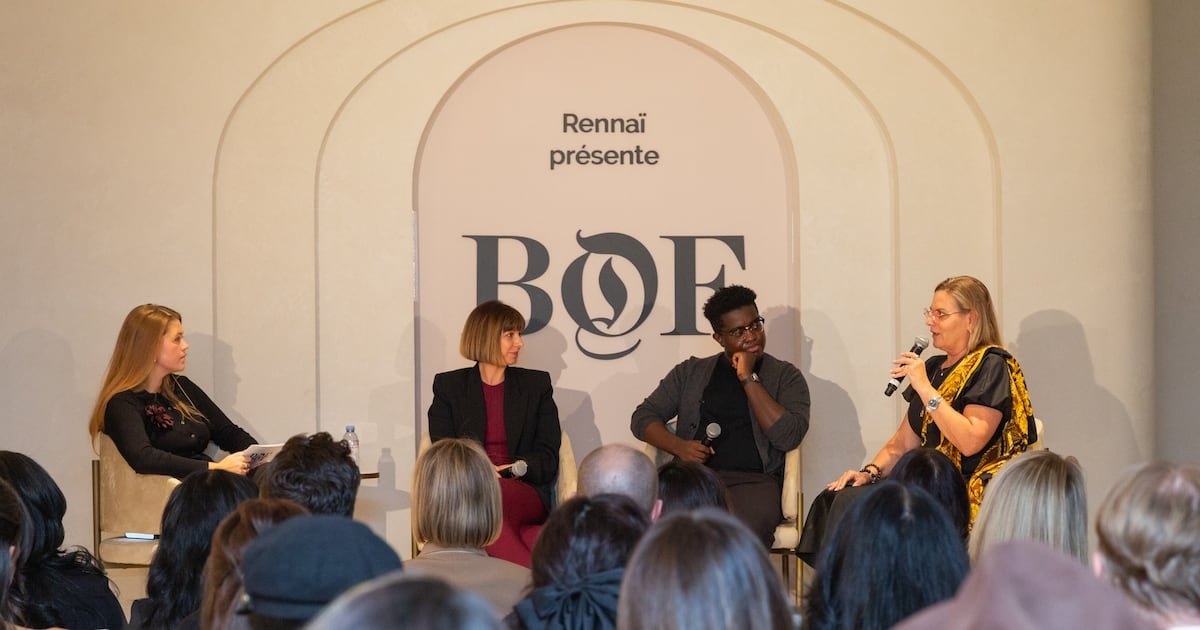
To chart how consumers’ needs are changing with regard to self-care, the drivers behind those changes and the innovation that will provide a strategic edge, BoF and Rennaï facilitated a panel in the Rennaï flagship store in Montréal last week. Moderated by BoF’s Alice Gividen, the talk featured Lauren Edelman, Victoria Beckham Beauty’s global chief marketing officer, Christiane Werron, Augustinus Bader’s global head of spas and clinics, and Dr. Julian Sass, a cosmetic scientist and brand consultant.
Below, BoF shares key insights from the conversation.
Bridge product development and marketing functions to enhance innovation
JS: When I speak to the sellers of raw materials, they say it requires a leap of faith from brands to take something new to market. If it’s not well established or you have an innovation that’s brand new — perhaps an innovative new peptide — then that education and awareness piece is so integral to market success.
Brands need an excellent marketing consultant to tell the entire story — it can’t be done with packaging and it must be done over time. It’s an investment for brands, but the payoff can be absolutely immense.
CW: While consumers are hungry for clinically proven ingredients, they will ultimately be convinced to buy your product from a very human touchpoint — be that sales points within your brand, or peer-to-peer recommendations.
We are living in a world where science and science-related skincare are developing so rapidly. The scientists have to speak to the brand educators and collaborate closely. Take epigenetics, which refers to how our behaviours and environment — our lifestyle, our mindset, even the skincare we use — affect how we age and the way our genes work. Our founder, Dr. Augustinus Bader, has operated within this space for more than four decades — but it continues to develop. The communication of that work is so important.
LE: From a brand perspective, spending time deep in the comments on socials keeps you very close to the customer, their feedback and their demands. For us at Victoria Beckham Beauty, it’s Victoria’s role as founder and as a creative leader that powers our product innovation. She leads and remains close to development — it’s how she likes to work and how she likes to bring the very best to her clients.
Educate consumers responsibly to strengthen sector credibility
CW: Those education moments have to be handled with care. I’m very cautious about holding back at those points of customer education and we are very thorough and considered when it comes to introducing new products, rituals or steps into a consumer’s routine.
During the pandemic, we almost saw overconsumption habits emerge within self-care. Some brands and influencers pushed overwhelming amounts of new products and recommended [complicated] routines. Beauty and skincare brands have a huge responsibility to educate more mindfully — we have to do right by the customer.
JS: The [democratisation] of content platforms means that incorrect information can spread rapidly and, to add more complexity, different consumer priorities can actually impact the accuracy of that advice even further. For many, it’s about efficacy; for others, it’s about that ritualistic element and less about performance, which is harder to quantify.
I think that consumers today are looking for help with the conflict of interest that stems from having so many contradicting voices in the beauty and self-care spaces. They are hungry for better products, but also better information. Consumers today are more savvy than ever before, but they are also fatigued. The standards to do business in this space are so much higher today.
LE: We have a real responsibility as beauty brands to operate more holistically, to focus on education and to think about the whole experience of the product. It’s not just efficacy, but it’s about the values of the people who made the product in the first place. It’s a hard thing to develop and to quantify — but that all encompassing experience is what will set brands apart.
Evaluate Customer Demand and Readiness to Inform Market-Driven Innovation
LE: Victoria [Beckham] values collaboration in order to answer consumer demands. It’s why we collaborated with Augustinus Bader for our category expansion into skincare — we knew that customers are reassured when they see expertise being leveraged in this way. We know that the concept of beauty and skincare adjacencies is really important to the informed consumer today. One example is our concealer, which is infused with Augustinus Baders’ skincare ingredients. These kinds of collaborations — bridging our expertise in both skincare and cosmetics — are responses to the consumer appetite that we are tracking.
JS: I talk to brands about community-led research and development as a central strategy. What are the consumer trends and concerns? Do those trends and concerns have longevity in the minds of consumers? And what ingredients can we offer to help solve them?
Currently, the concept of “cortisol face” is dominating conversations on social media and the providers of raw materials are working to develop solutions to combat the effects of raised cortisol levels. Many brands can’t develop peptides or exosomes in-house— but armed with consumer trends, there are innovators that can help to power innovation.
CW: What we are seeing from our customer base is simple, clear demand for the very best ingredients that can be found on the market. As the science is always evolving, every product that we launch has to go through deeply thorough, formal clinical trials to prove the efficacy of the product itself — it’s how we assure customers of market readiness. It’s imperative, when you operate at the front of market innovation.
Enhance high-touch service models to support client self-care demands
LE: The timing of Victoria Beckham Beauty — launching right before the pandemic — has meant that we have always operated in digital spaces by necessity and we have remained largely digital for the last five years. But as we seek new partners, new wholesalers, we are starting to strategise on ways to bring a deeper human connection into a digital space. Many brands are exploring AI-powered consultations, but how we achieve that human connection digitally and replicate that high touch service is an on-going conversation.
CW: To be on the winning path, brands need to build that connection with the customer — there is little sense in self-care without the foundational brand values that underpin it.
Self-care is relational. As a consumer, it’s much deeper than buying a product or applying makeup — it’s about the value that we gain from the interaction, the feeling that comes from the product both in terms of efficacy and in terms of mood and mindset. I’m keen to hear more brands talk about that holistic perspective, as it’s what will matter most to our customers.
It comes back to the concept of brand responsibility — we need high-touch service to introduce new science, new product innovation and how it services the skin. Currently, it is the only way to achieve that all-important personalised experience.
JS: We are seeing brands become increasingly aspirational about how to scale personalisation in order to meet consumer demand. At this stage in self-care, personalisation is possible, but it is not bespoke — questionnaires and product recommendations aren’t achieving what consumers seek. That really individualised element is a way off — and so that human touch is going to remain key.
