


June 6, 2021
• Last updated: September 10, 2026
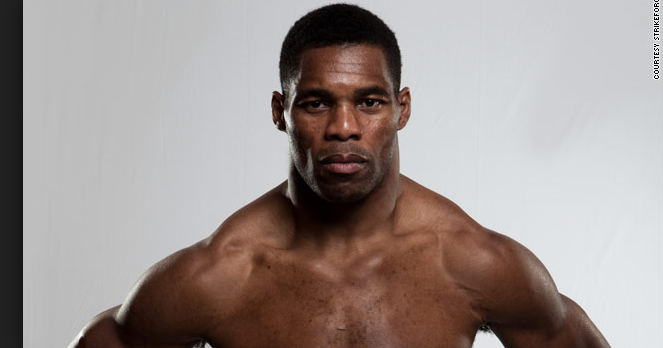
As a boy I followed the Dallas Cowboys, and one of the players I really admired was Herschel Walker. He was a beast, but the guy could move like nothing else.
A few years ago I read somewhere that Walker’s legendary, granite-like physique was built not by lifting weights but through bodyweight training for MMA.
Now I reallywanted to know the full nature and motivation behind Walker’s unorthodox training program. I was able to finally discover it by getting my hands on a copy of Basic Training, an out-of-print book he wrote in the 80s along with Dr. Terry Todd, an Olympic weightlifter and conditioning expert. The book remains so sought-after that thirty years after its publication, used copies continue to command a crazy premium.
Below you’ll find the background on how Walker developed the unorthodox bodyweight training program he’s been doing for over forty years, as well as details as to what it consists of. The Walker Workout is definitely not for everyone, but its exercise components are in many ways the least interesting thing about it. Walker’s story and overall fitness philosophy — one that eschews excuses and convention, and prizes autonomy, improvisation, experimentation, and consistency — offer interest and inspiration for all.
The Origins of Herschel Walker’s Bodyweight Workout
Walker grew up on a farm in rural Johnson County, Georgia along with six siblings. While his family didn’t have a lot of money, they got by, and his household was filled with plenty of love and support.
As a boy, Herschel had a speech impediment, was short and chubby, and didn’t seem destined for athletic greatness. In running races with siblings and playing games with friends, he was slow and uncoordinated, struggled to keep up, and felt lacking in the confidence and endurance to really push himself. In elementary school, he was bullied and beat up by his classmates, and thus often chose to stay inside during recess rather than going out to play.
After finishing the sixth grade, Walker decided he wanted to turn things around for himself. He approached a track coach who had mentored his older brothers and told him he “wanted to get bigger and stronger and faster and be better at sports.” As Walker remembers, the coach responded that “it was simple but I had to work hard at it. He said to do push-ups, sit-ups, and sprints. That’s all he said. But it was enough.”
Herschel went home and got started on his new bodyweight program straightaway; his parents had always taught him that “you can’t make excuses in life, you’ve got to get it done,” and he thus made do with what was available:
Herschel’s commitment to his workouts was religious — he never missed a day. He would crank out his push-ups and sit-ups during TV commercial breaks at night, and did his sprints on the hills and fields near his home — even in the summer, under the hot Georgia sun. He particularly liked to run when his father had recently plowed up the ground, as the consistency of the dirt became like heavy sand and added an extra challenge. He’d also chase and run alongside the family’s horse and bull, changing direction as the animals did in order to develop his agility and reaction time. There was a chin-up bar out back and he added chin-ups and pull-ups to his routine as well.
While perfect pushups, chin-ups, sit-ups, and sprints formed the core of Walker’s workout, they were hardly the only exercises he did. Herschel did different bodyweight exercises like squats and dips, loaded hay and performed other chores around the farm, wrestled with his brothers, took up taekwondo, played tennis with friends, and even practiced for and entered dance competitions with his sister. He later theorized that this diversity of activity contributed greatly to his athletic success (
<p><strong>Variety</strong>. From martial arts to dance, Walker engaged in a wide range of physical activities and exercises throughout his life, and continues to do so. As he told
