

January 25, 2026
• Last updated: June 11, 2026
When the physician and psychiatrist Leonard Schwartz surveyed his life at middle-age, he was not particularly happy with the state of himself as a physical specimen. Decades of smoking, overwork, and living a sedentary strength, dropped his weight, and exponentially boosted his vim and vigor.
The name of his system was “Heavyhands” and with the publication of Heavyhands: The Ultimate Exercise and Heavyhands Walking in the 1980s, Schwartz’s methodology became something of a national sensation. Though the workout has now largely been forgotten, it’s deserving of a resurrection.
The idea for Heavyhands grew out of Schwartz’s discovery that the athletes with the highest VO2 max (generally considered the best indicator of cardiovascular fitness) were not cyclists, nor runners, but cross-country skiers.
From this insight, Schwartz drew a conclusion that was both intuitive and seemingly neglected: when it came to achieving cardiovascular fitness, “Four limbs are better than two.”
Most forms of cardio, the doctor observed, greatly emphasized the lower body over the upper. Activating the latter as much as the former, Schwartz hypothesized, could thus significantly increase the workload, and the subsequent health benefits, of exercise.
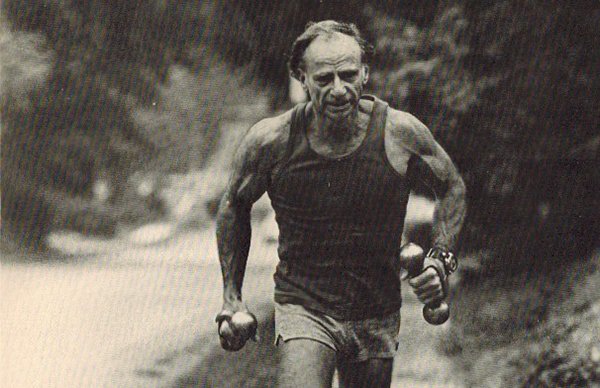
Schwartz began to test his theory both on himself and in a laboratory by taking small dumbbells in each hand and then performing all sorts of exercises: striding and swinging the dumbbells using the “double pole” maneuver cross-country skiers employ; running (for distance and in place); lunging, jumping, and dancing; and just generally moving his legs and swinging dumbbell-laden arms in all kinds of directions and combinations.
While all these varied calisthenics proved effective, Schwartz found that doing the “Heavyhands Walk” — essentially walking while pumping dumbbells with one’s arms — was the “best way to begin combined, four-limbed movements” and the most natural form of heavy-handed exercise.
The Benefits of Heavyhands Walking
Walking is an oft-recommended exercise, and while it’s certainly better than doing nothing, it’s a pretty light form of activity, with lightweight benefits to match. A Heavyhands Walk transforms a pedestrian saunter into what Dr. Schwartz believed is “an exercise that makes one more mechanically strong and aerobically powerful than any other combination of exercises could.” Schwartz called it “Walk Plus” — an activity that couples all the normal benefits of walking (gets you outside, doesn’t involve real skill, can be done anywhere) with these additional advantages as well:
Whole body exercise. Even in our day-to-day life, outside of a dedicated workout, our legs get “exercise” by default by having to carry us from one place to another. Our arms, in contrast, typically just kind of hang there. Even when we do engage in intentional cardio, our lower bodies often do a greatly disproportionate amount of the work; the arms and torso are fairly inert in cycling, for example, and even when running, one’s arms swing through the air without resistance. That leaves a lot of the body on the passive table; as Schwartz observed, “While arms are small compared to legs, the upper body contains fully 65 percent of our total muscle mass!” Heavyhands engages all the muscle groups of the body, bottom to top.
Strength + cardio. While Heavyhands is primarily a cardiovascular exercise, it does build a bit of strength too. While doing thousands of repetitions with light weights isn’t going to make you big and strong, it does engage the muscles more than some other types of cardio, and athletes who have tried it have found surprising carryover improvements in their performance in their primary sports.
The same kind of benefit from doing loaded carries can of course be found in something like rucking. But not only actively carrying but manipulating the weight engages different muscles, and makes one’s walk more inefficient and effortful; carrying weight with the hands may produce up to twice the workload of carrying it supported on the back.
Convenient. By engaging the whole body, Heavyhands gives you a better workout, in less time. Plus, you hardly need any equipment and can do it anywhere, even packing your little dumbbells on a trip.
Improves cardiovascular health. Schwartz’s testing found that by adding the pumping of weights, and engaging all four limbs simultaneously, the workload, and thus the cardiovascular benefits, were greatly improved compared to conventional walking. For example, vigorously pumping 3-lb weights while walking briskly generated 2.5-3X the workload of walking without the weights, and at certain levels, Heavyhands Walking approaches the cardiovascular workload of jogging.
Effective, but low impact. Even though the cardiovascular workload from a Heavyhands walk does approach that of jogging, it’s a form of exercise that is much gentler on the body. With most forms of cardio, if you want to up your workload, your only option is to move your legs faster and harder, and that can lead to injuries. With Heavyhands, you can increase the intensity in both arms and legs, distributing the effort. And unlike with running, both legs never leave the ground at the same time, minimizing the impact of the movement. For these reasons, it can be a great cardio workout for those who are recovering from certain injuries that prevent them from engaging in their usual modality, or for those who are older and simply feeling the wear and tear of time.
Go longer, more comfortably. Relying on the intensity of your legs to power your workout can be uncomfortable and lead to the premature cessation of one’s workout. Schwartz found that by incorporating all four limbs, exercise felt easier and more comfortable, allowing people to keep at it longer.
Fat loss and improved body composition. Having observed that people hated to be deprived and almost never stuck with modifications to their eating, Dr. Schwartz did not believe in dieting for weight loss. Instead, for the exact reasons we recently outlined here, he advocated for the “Overall legitimacy of exercise as the supreme weight-controlling device.” Confident that you could shed pounds simply by adding the exercise habit alone, he thought Heavyhands — and the way it engaged the whole body and allowed for longer periods of steady-state cardio — was the most effective workout for achieving this aim.
